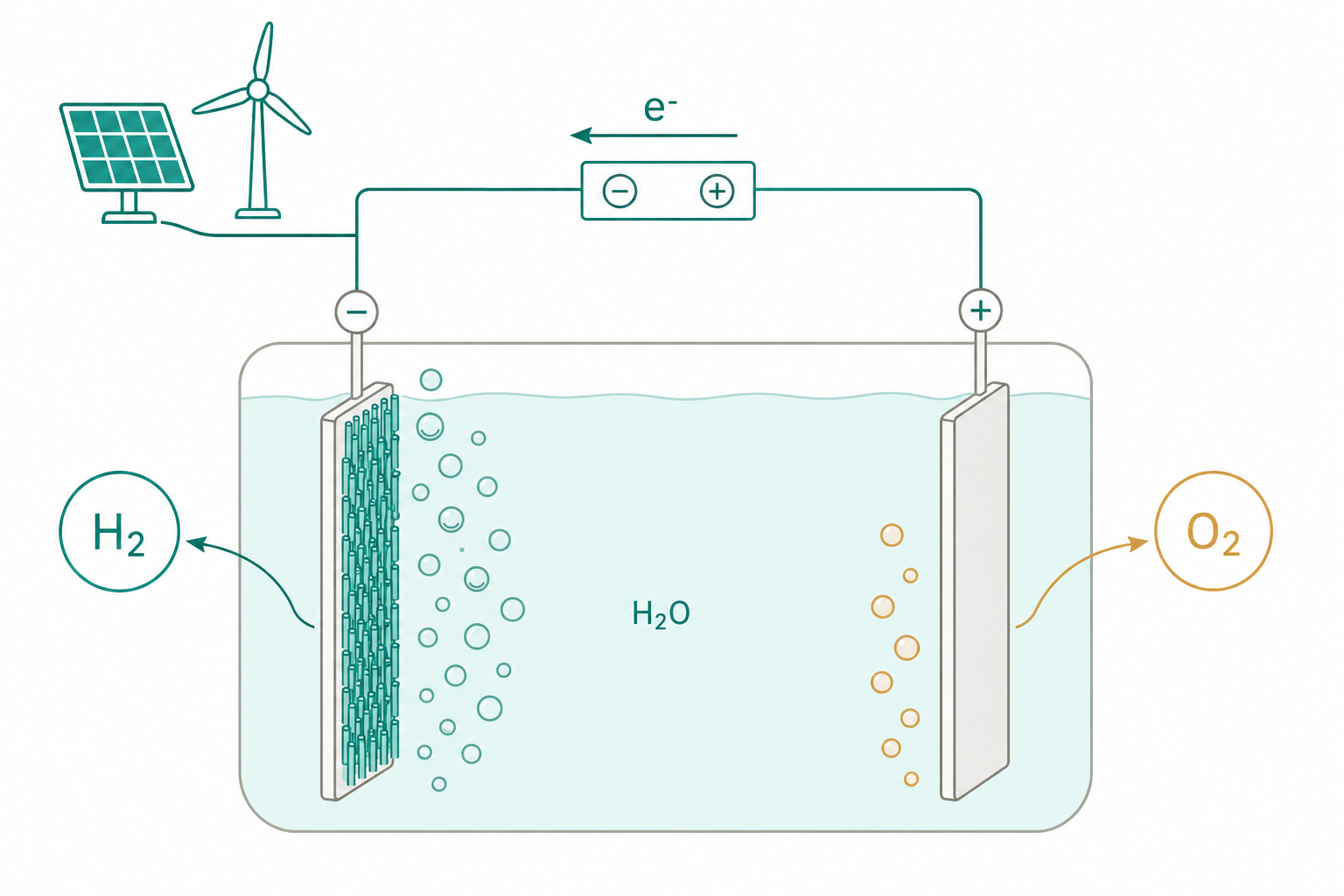
물 전기분해를 통한 청정 수소·산소 생산. 지구에 풍부한 원소 기반 전기촉매 설계와 계면 반응 메커니즘 규명에 집중합니다.
Keywords
HER / OER · Water splitting · Electrocatalysis
대표 논문
- 1
Engineered Electronic States of Transition Metal Doped TiO2 Nanocrystals for Low Overpotential Oxygen Evolution Reaction
Nitish Roy; Youngku Sohn; Kam Tong Leung; Debabrata Pradhan
J. Phys. Chem. C 2014, 118, 29499-29506. DOI ↗ 📊 인용 ↗
📄 초록 (English) ▾
Electrochemical oxygen evolution reaction (OER) involves high overpotential at the oxygen evolving electrode and thereby suffers significant energy loss in the proton exchange membrane water electrolyzer. To reduce the OER overpotential, precious ruthenium and iridium oxides are most commonly used as anode electrocatalyst. Here we report marked reduction in overpotential for the OER using transition metal (TM) doped TiO 2 nanocrystals (NCs). This reduction in overpotential is attributed to d-orbitals splitting of the doped TMs in the TM-doped TiO 2 NCs and their interactions with the oxyradicals (intermediates of OER) facilitating the OER. The d-orbital spitting of TMs in TM-doped TiO 2 NCs is evident from the change in original pearl white color of undoped TiO 2 NCs and UV–vis absorption spectra.
- 2
Highly Active Tungsten Oxide Nanoplate Electrocatalysts for the Hydrogen Evolution Reaction in Acidic and Near Neutral Electrolytes
Arpan Kumar Nayak; Manju Verma; Youngku Sohn; Parag A. Deshpande; Debabrata Pradhan
ACS Omega 2017, 2, 7039-7047. DOI ↗ 📊 인용 ↗
📄 초록 (English) ▾
High Resolution Image Download MS PowerPoint Slide An efficient, cost-effective, and earth-abundant catalyst that could drive the production of hydrogen from water without or with little external energy is the ultimate goal toward hydrogen economy. Herein, nanoplates of tungsten oxide and its hydrates (WO 3 ·H 2 O) as promising electrocatalysts for the hydrogen evolution reaction (HER) are reported. The square-shaped and stacked WO 3 ·H 2 O nanoplates are synthesized at room temperature under air in ethanol only, making it as a promising green synthesis strategy. The repeated electrochemical cyclic voltammetry cycles modified the surface of WO 3 ·H 2 O nanoplates to WO 3 as confirmed by X-ray photoelectron and Auger spectroscopy, which leads to an improved HER activity. Hydrogen evolution is further achieved from distilled water (pH 5.67) producing 1 mA cm –2 at an overpotential of 15 mV versus the reversible hydrogen electrode. Moreover, WO 3 ·H 2 O and WO 3 nanoplates demonstrate excellent durability in acidic and neutral media, which is highly desirable for practical application. Improved hydrogen evolution by WO 3 (200) when compared to that by Pt(111) is further substantiated by the density functional theory calculations.
- 3
ZnO-TiO2 Core–Shell Nanowires: A Sustainable Photoanode for Enhanced Photoelectrochemical Water Splitting
Kyuwon Jeong; Prashant R. Deshmukh; Jinse Park; Youngku Sohn; Weon Gyu Shin
ACS Sustainable Chemistry & Engineering 2018, 6, 6518-6526. DOI ↗ 📊 인용 ↗
📄 초록 (English) ▾
We present the synthesis of a unique vertically aligned ZnO-TiO2 core–shell nanowires (NWs) heterostructure on an Si-wafer using a chemical vapor deposition method. The structural study shows the well-developed ZnO-TiO2 core–shell NWs heterostructure. This unique ZnO-TiO2 core–shell NWs heterostructure displays a photocurrent density of 1.23 mA cm–2, which is 2.41 times higher than pristine ZnO NWs. A cathodic shift in the flat band potential and a lower onset potential of a ZnO-TiO2 core–shell NWs heterostructure over ZnO NWs indicates more favorable properties for photoelectrochemical water splitting with a photoconversion efficiencey of 0.53%. A higher photocurrent density/photoconversion efficiency is due to the effective addition of photogenerated electron–hole separation originating from the ZnO NWs core and the conformal covering of a amorphous TiO2 passivation shell. Therefore, these results suggest that the vertically aligned one-dimentional ZnO-TiO2 core–shell NWs heterostructure is a promising photoanode for solar energy conversion devices.
- 4
Facile Green Synthesis of WO3·H2O Nanoplates and WO3 Nanowires with Enhanced Photoelectrochemical Performance
Arpan Kumar Nayak; Youngku Sohn; Debabrata Pradhan
Crystal Growth & Design 2017, 17, 4949-4957. DOI ↗ 📊 인용 ↗
📄 초록 (English) ▾
The synthesis of nanostructured materials with controlled shape without using a capping agent and/or a hazardous chemical is one of the major existing challenges. Herein, we report a facile precipitation method to synthesize stacked orthorhombic tungsten trioxide hydrate (WO 3 ·H 2 O) nanoplates by simply mixing WCl 6 (0.025 M) in ethanol at room temperature for 1 h. On subsequent solvothermal treatment of WO 3 ·H 2 O nanoplates at 200 °C in ethanol, formation of monoclinic tungsten trioxide (WO 3 ) nanowires of <20 nm diameter is demonstrated. The morphology evolution of WO 3 nanowires from WO 3 ·H 2 O nanoplates and change in growth direction through dissolution and recrystallization process is further confirmed by varying the solvothermal duration and temperature. The as-synthesized WO 3 ·H 2 O nanoplates and WO 3 nanowires are used as photoanodes for the hydrogen generation through photoelectrochemical (PEC) water splitting in a neutral pH. The photocurrent density of WO 3 nanowires is found ∼21 times higher than that of WO 3 ·H 2 O nanoplates at 1.0 V vs saturated calomel electrode (SCE) and also higher than the reported WO 3 nanostructures. The superior PEC performance of WO 3 nanowires is justified on the basis of its (200) oriented one-dimensional morphology, large surface area, and small interfacial charge transfer resistance.
- 5
Construction of type-II SnO2/InGaN nanorods heterostructure toward high photoelectrochemical performance
C. Thota; S. Ramu; C. Gangadhara; G. Murali; J. H. Yang; D. P. Upare; N.-H. Bak; Y. K. Kshetri; Y. Sohn; M. Reddeppa; M.-D. Kim
Appl. Phys. Lett. 2023, 123, 203903. DOI ↗ 📊 인용 ↗
📄 초록 (English) ▾
Exploring highly efficient and stable photoelectrode material is essential for high-performance photoelectrochemical (PEC) water-splitting applications. III-nitride semiconductors, particularly InGaN, have been considered as prospective materials for PEC hydrogen evolution. However, their surface states and other recombination centers, which enhance the charge recombination kinetics, are bottlenecks for the high PEC performance. In this work, we report the construction of type-II heterojunction by sputter depositing SnO2 on InGaN nanorods (NRs) to promote interfacial carrier transport and thereby enhance PEC performance. The energy band offsets at the SnO2/InGaN NRs interface were analyzed by x-ray photoelectron spectroscopy. Type-II heterojunction was defined at the SnO2/InGaN NRs interface with a valence band offset of 0.77 eV and conduction band offset of 0.25 eV. The photocurrent density of the SnO2/InGaN NRs photoanode is 7.09 mA/cm2 at 0.77 V vs Ag/AgCl electrode with 80 nm SnO2 thickness, which is ∼14-fold higher than that of the pristine InGaN NRs photoanode. Furthermore, the applied bias photo-to-current efficiency of SnO2/InGaN NRs photoanode records 3.36% at 0.77 V vs Ag/AgCl electrode. The enhanced PEC performance is mainly ascribed to the formation of high-quality SnO2/InGaN NRs heterojunction that enforces the directional charge transfer and substantially boosts the separation of photogenerated electron–hole pairs at the interface of InGaN NRs and SnO2. Overall, this work sheds light on the promising strategy to design and fabricate III-nitride nanostructures-based photoelectrodes for feasible PEC water-splitting applications.