Publications
대표 · 최근 논문
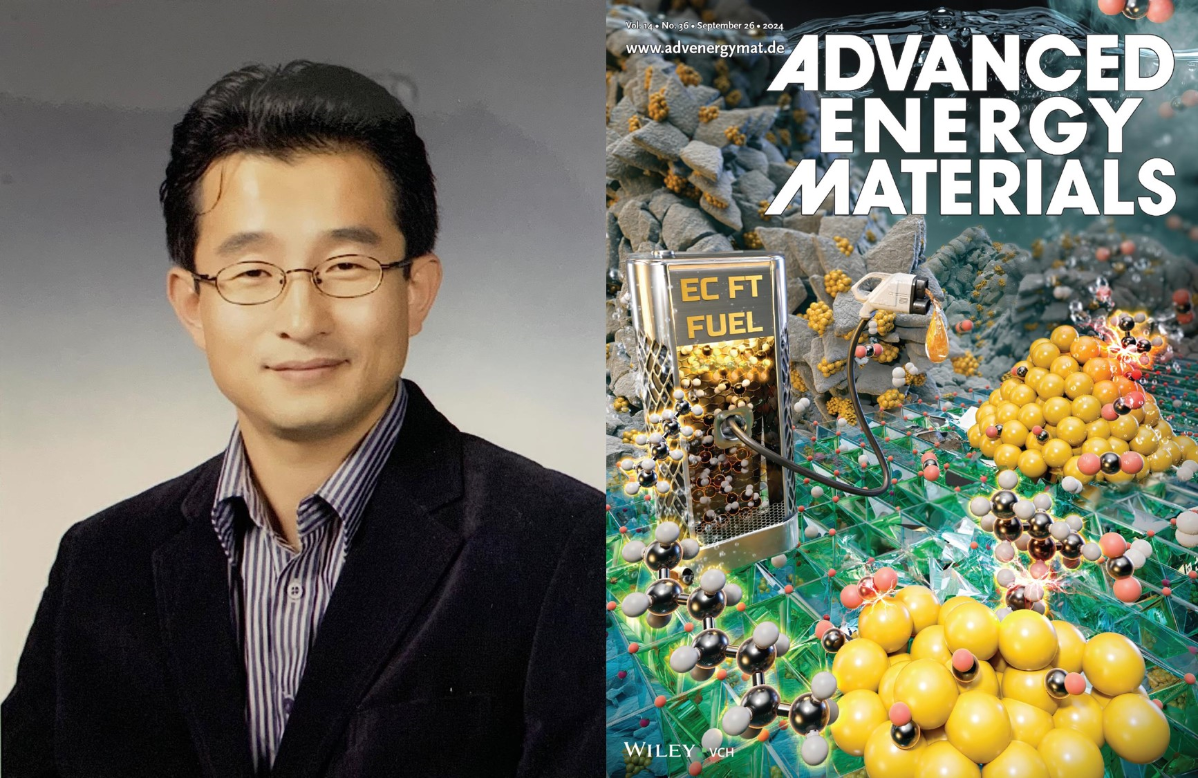
저널 표지 논문
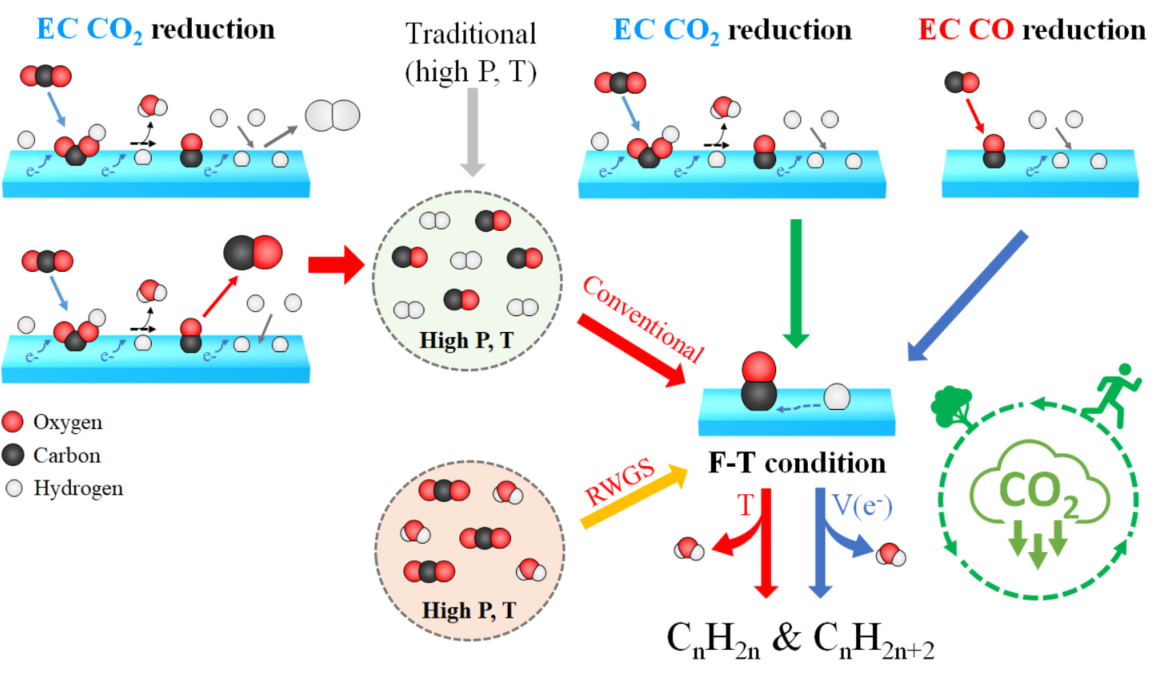
Exploring Direct Electrochemical Fischer–Tropsch Chemistry of C1–C7 Hydrocarbons via Perimeter Engineering of Au–SrTiO3 Catalyst
Advanced Energy Materials · 2024 Link ↗
-
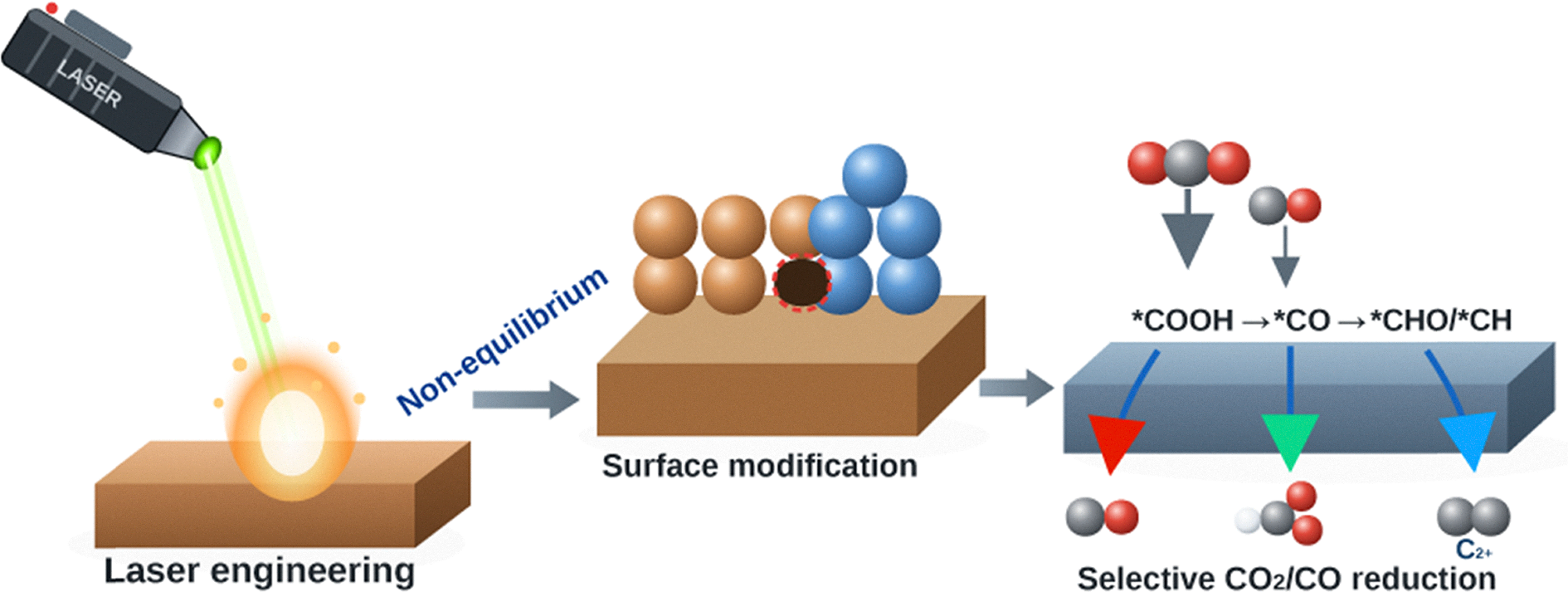
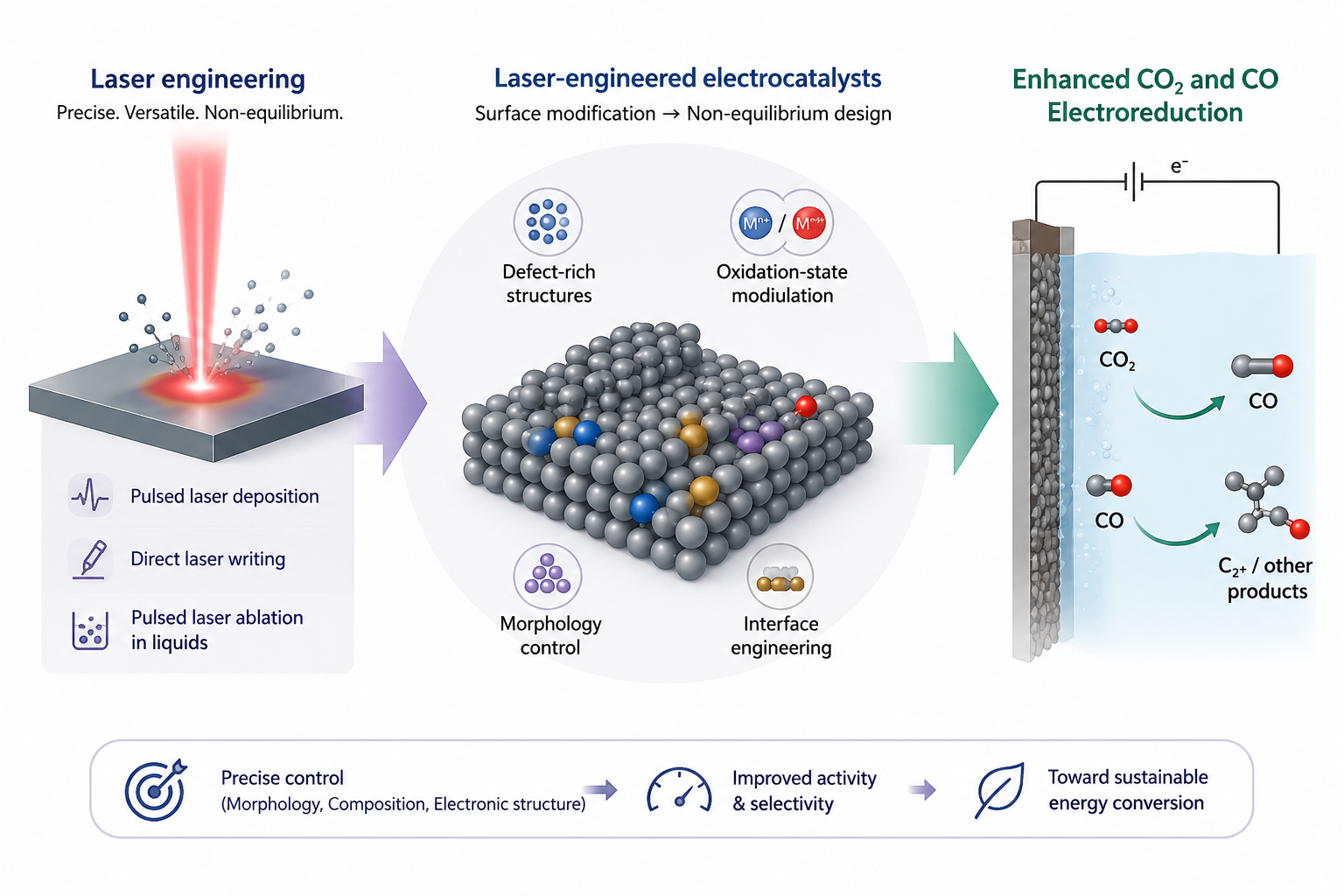
Laser-engineered electrocatalysts for CO2 and CO reduction: From surface modification to non-equilibrium catalyst design
Mater. Horiz. 2026. DOI ↗ 📊 인용 ↗
📄 초록 ▾
레이저 가공은 뛰어난 공간·시간 정밀도로 전기촉매의 표면과 계면을 설계할 수 있는 강력한 플랫폼으로 부상했다. 대체로 평형 구조에만 접근하는 기존 합성법과 달리, 레이저 조사는 국소적인 에너지 전달과 초고속 급랭을 통해 비평형 상(phase), 결함이 풍부한 미세구조, 동적으로 설계된 계면을 만들어 낼 수 있다. 이러한 고유한 능력은 전기화학적 CO2 및 CO 환원에서 촉매 활성과 선택성을 조절할 새로운 가능성을 제공한다. 본 총설은 레이저로 설계한 전기촉매의 최근 진전을 정리하며, 레이저–물질 상호작용의 기본 원리와 펄스 레이저 증착(PLD), 직접 레이저 묘화(direct laser writing), 액상 펄스 레이저 어블레이션(PLAL)을 비롯한 제조 전략에 중점을 둔다. 레이저 변수가 표면 재구성, 산화 상태 조절, 결함 형성, 계면 설계를 어떻게 좌우하며 이를 통해 구조화된 전극, 산화물–금속 계면, 계면활성제가 없는 나노소재를 구현하는지 논의한다. 또한 대표적인 촉매 시스템을 통해 레이저에 의한 변형이 촉매 성능과 반응 경로에 미치는 영향을 보인다. CO2·CO 전기촉매 분야에서 레이저 가공의 활용은 아직 상대적으로 덜 탐구되어 있으나, 형상·조성·전자 구조를 동시에 제어할 수 있다는 점에서 차세대 촉매 설계를 위한 유망한 플랫폼이 된다. 끝으로 메커니즘 규명, 오퍼란도(operando) 분석, 공정 변수 표준화, 대량 생산 가능성 등 현재의 과제와 앞으로의 기회를 논의한다. 레이저 가공은 단순한 표면 개질 도구를 넘어 비평형 전기촉매 설계와 지속가능한 에너지 변환 기술을 위한 다목적 플랫폼으로 발전해 갈 것으로 전망된다.
※ 연구실에서 옮긴 비공식 번역입니다. 정확한 표현은 원문·DOI를 확인해 주세요.
원문 (English) ▾
Laser processing has emerged as a powerful platform for engineering electrocatalyst surfaces and interfaces with exceptional spatial and temporal precision. Unlike conventional synthesis routes that largely access equilibrium structures, laser irradiation can generate non-equilibrium phases, defect-rich microstructures, and dynamically engineered interfaces through localized energy delivery and ultrafast quenching. These unique capabilities offer new opportunities for tailoring catalytic activity and selectivity in electrochemical CO2 and CO reduction. This review summarizes recent advances in laser-engineered electrocatalysts, with emphasis on the fundamental principles of laser–matter interactions and fabrication strategies including pulsed laser deposition, direct laser writing, and pulsed laser ablation in liquids. We discuss how laser parameters govern surface restructuring, oxidation-state modulation, defect formation, and interfacial engineering, enabling the creation of structured electrodes, oxide–metal interfaces, and surfactant-free nanomaterials. Representative catalyst systems are highlighted to illustrate the impact of laser-induced modifications on catalytic performance and reaction pathways. Although the application of laser processing in CO2 and CO electrocatalysis remains relatively underexplored, its ability to simultaneously control morphology, composition, and electronic structure positions it as a promising platform for next-generation catalyst design. Finally, current challenges and future opportunities are discussed, including mechanistic understanding, operando characterization, parameter standardization, and scalable manufacturing. We anticipate that laser processing will evolve beyond a surface-modification tool toward a versatile platform for non-equilibrium electrocatalyst design and sustainable energy-conversion technologies.
-
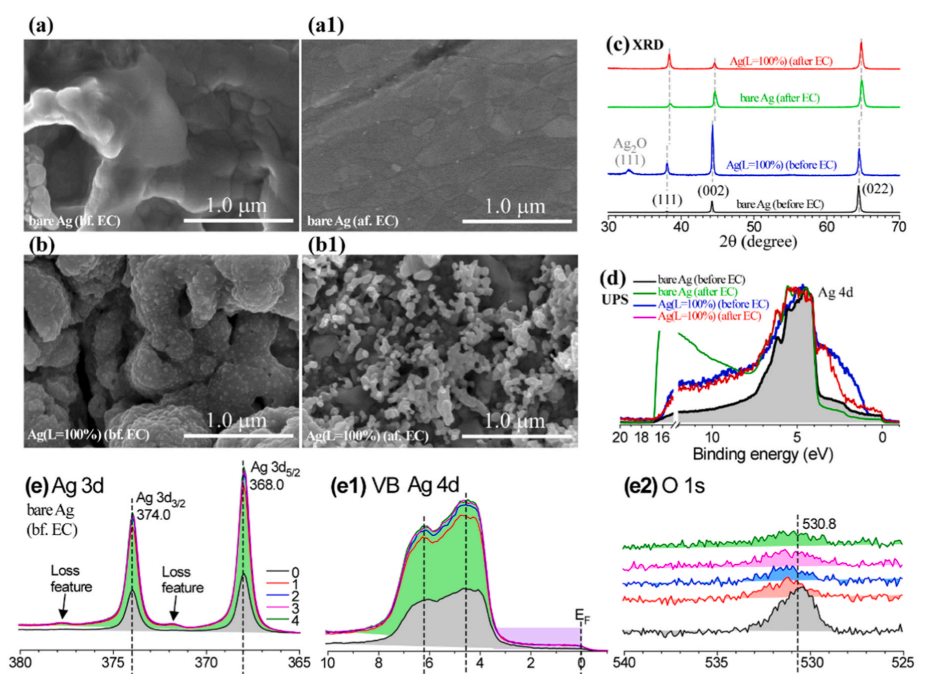
Laser-engineered Ag/Ag oxide interfaces for tunable CO2 reduction: Mechanistic insights from experiment and theory
Mater. Today Energy 2026. DOI ↗ 📊 인용 ↗
📄 초록 ▾
은(Ag) 전극의 계면 공학은 전기화학적 이산화탄소 환원(CO2RR)의 활성과 선택성을 조절하는 효과적인 전략이다. 본 연구에서는 제어된 적외선(1064 nm) 레이저 처리로 Ag 및 산화 은(Ag/AgxO) 전극을 제조하고, KHCO3 전해질과 인산염 전해질에서 성능을 평가하였다. 레이저로 유도된 표면 재구성은 산화 상태, 결정학적 배향 및 계면 전자 특성을 변화시켜 전해질과 전위에 따른 생성물 분포의 변화를 일으켰다. KHCO3 전해질에서는 CO가 주생성물로 유지된 반면, 인산염 전해질에서는 레이저 처리 강도가 증가할수록 CO 선택성이 크게 향상되었다. 산화된 Ag 표면에서는 수소, 폼산염 및 C2+ 탄화수소 생성이 억제되었다. 생성물 선택성은 뚜렷한 전위 의존성을 보였다. CO와 C2+ 탄화수소는 중간 전위에서 최대값을 나타냈고, 폼산염 생성은 더 음의 전위에서 증가하였다. 장쇄 C2+ 탄화수소는 Fischer-Tropsch형 성장 경향을 따랐다. 전기화학 임피던스 분광법을 통해 전하 전달 속도론과 계면 정전용량의 변화를 확인하였다. 밀도 범함수 이론 계산에서는 COOH* 중간체를 거치는 CO 생성이 Ag(111)과 Ag2O(111)에서 유리한 반면, HCOO*를 거치는 폼산염 생성은 금속 Ag에서 더 유리한 것으로 나타났다. 이 결과는 Ag/산화 Ag 계면이 CO2RR 경로를 조절하는 방식을 규명한다.
※ 연구실에서 옮긴 비공식 번역입니다. 정확한 표현은 원문·DOI를 확인해 주세요.
원문 (English) ▾
Interface engineering of silver (Ag) electrodes provides an effective strategy to tune activity and selectivity in electrochemical CO2 reduction (CO2RR). Here, Ag and Ag oxide (Ag/AgxO) electrodes were prepared via controlled infrared (1064 nm) laser treatment and evaluated in KHCO3 and phosphate electrolytes. Laser-induced surface restructuring modified oxidation states, crystallographic orientations, and interfacial electronic properties, leading to electrolyte- and potential-dependent shifts in product distribution. In KHCO3 electrolyte, CO remained the dominant product, whereas phosphate electrolyte significantly enhanced CO selectivity with increasing laser treatment. Oxidized Ag surfaces suppressed hydrogen, formate, and C2+ hydrocarbons. Product selectivity showed clear potential dependence: CO and C2+ hydrocarbons peaked at moderate potentials, while formate formation increased at more negative potentials. Long-chain C2+ hydrocarbons followed a Fischer-Tropsch-like growth trend. Electrochemical impedance spectroscopy revealed changes in charge-transfer kinetics and interfacial capacitance. Density functional theory calculations indicate that CO formation via COOH intermediates is favored on Ag(111) and Ag2O(111), whereas formate formation via HCOO* is more favorable on metallic Ag. These results clarify how Ag/Ag oxide interfaces regulate CO2RR pathways.
News
연구실 소식
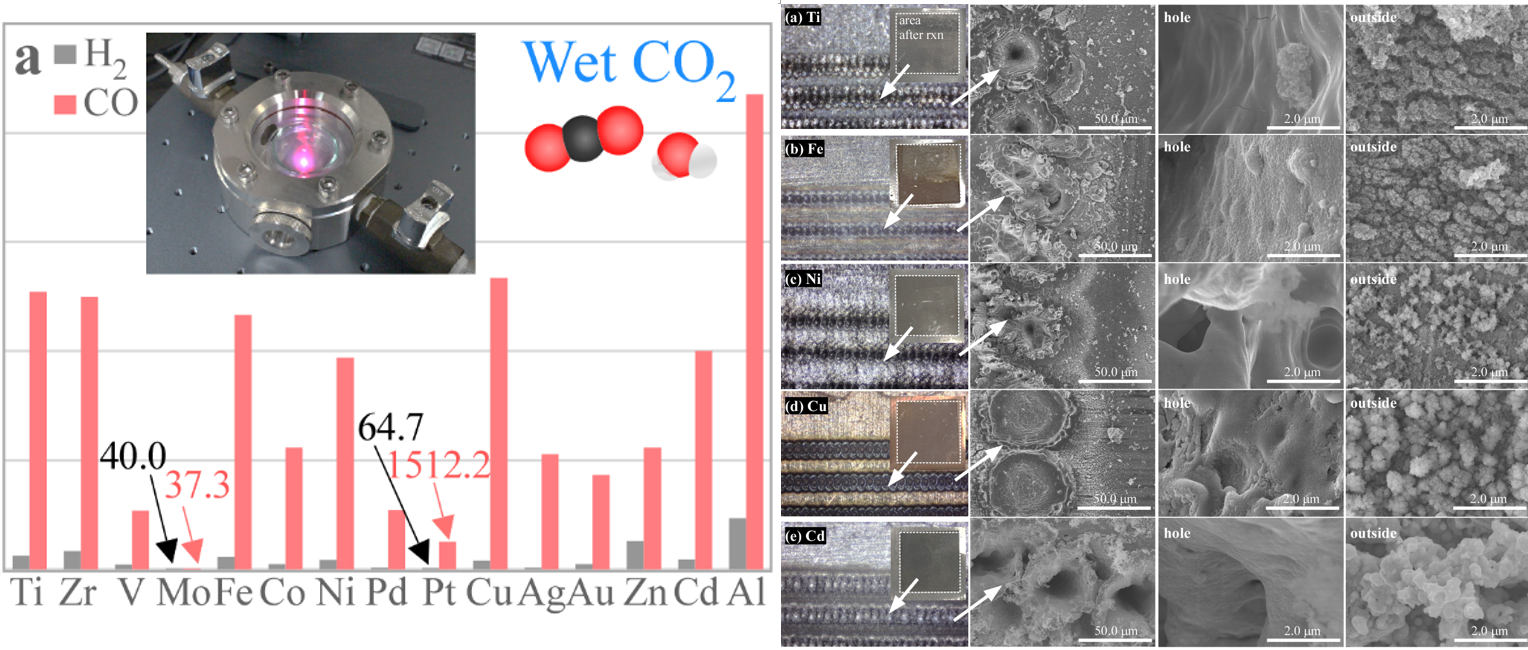
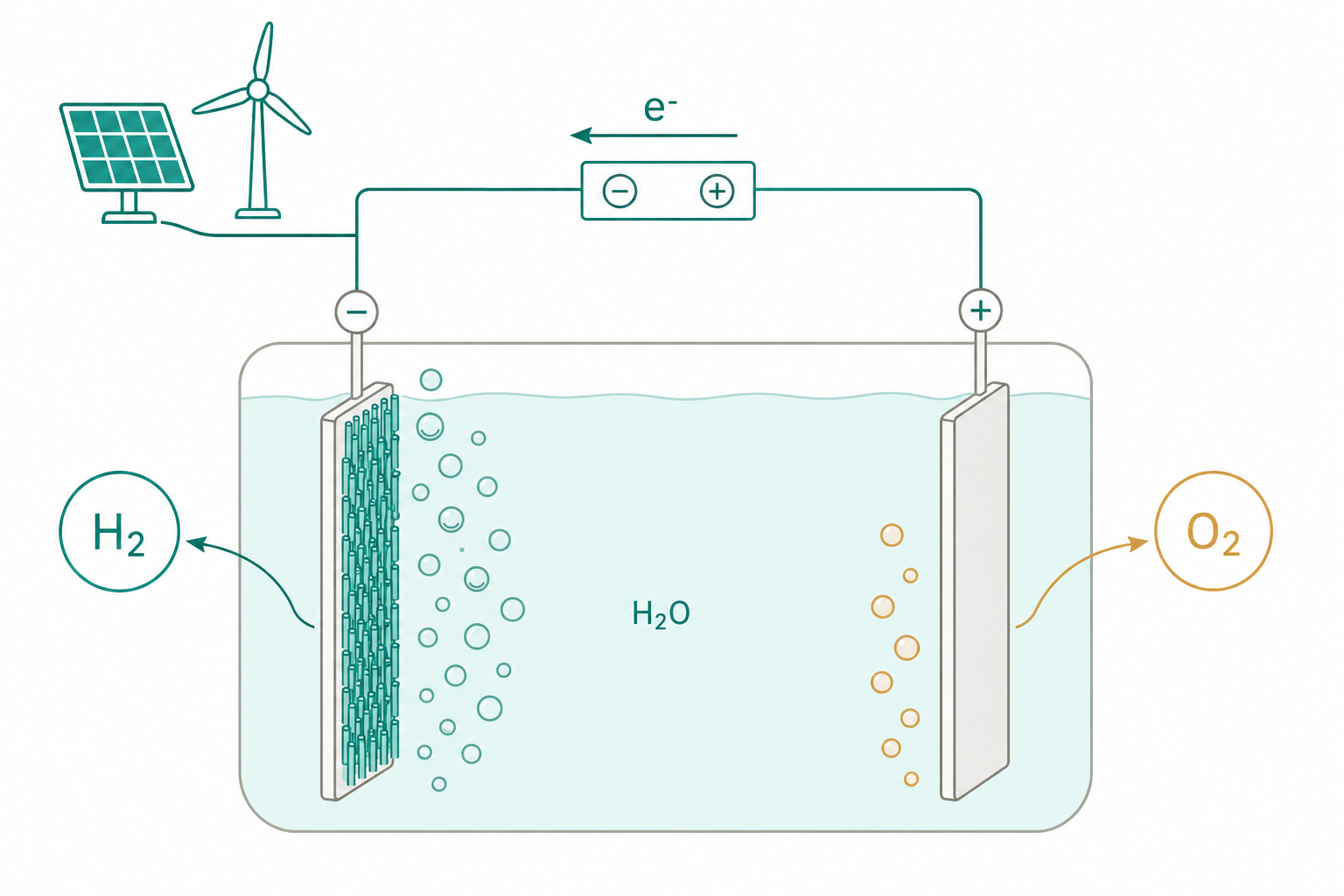
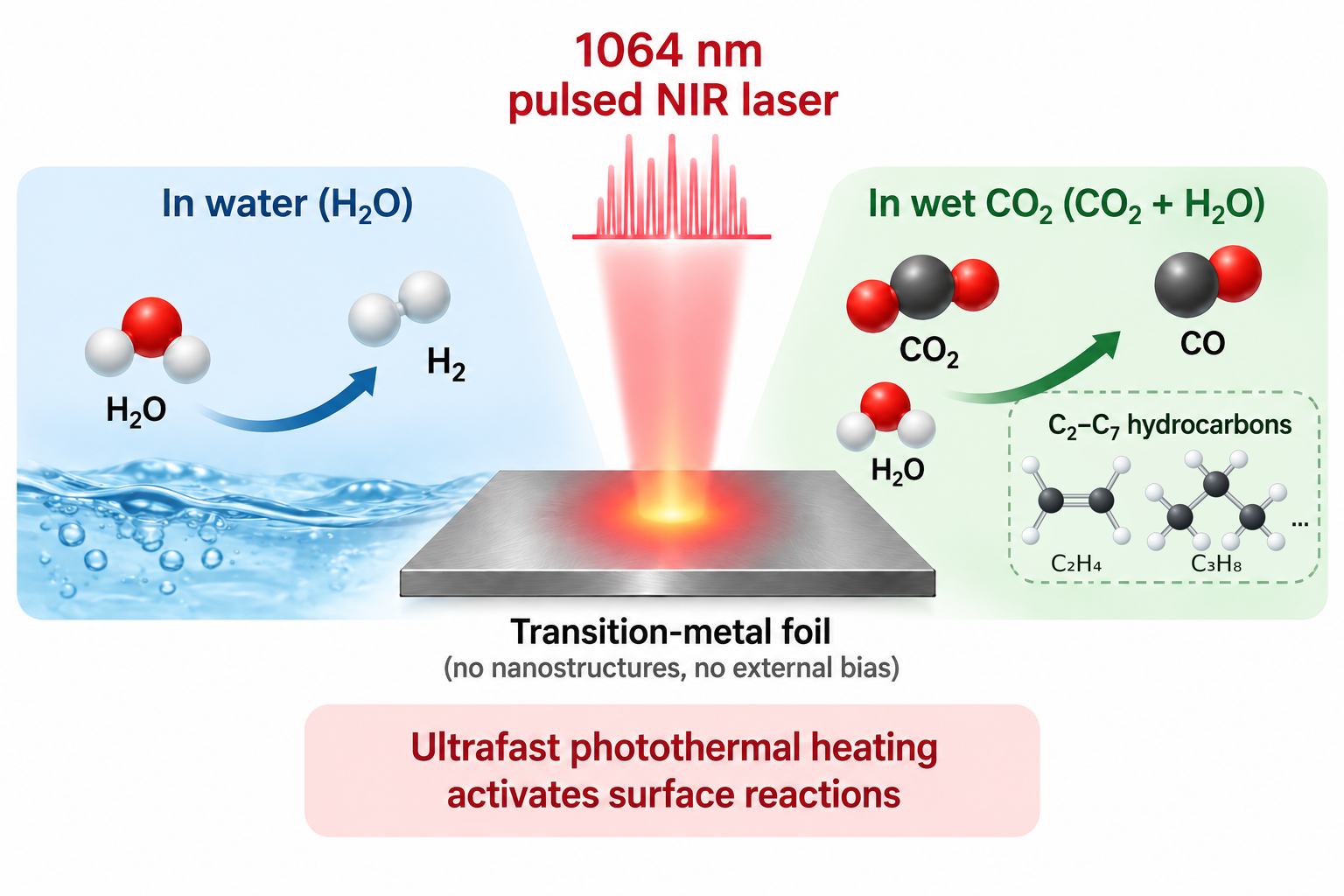
- 2026-09-14 손영구·윤일선 교수팀, 레이저만으로 물·이산화탄소 전환 기술 제시 재료 분야 국제학술지 『Advanced Functional Materials』 게재 - 나노구조·반도체 광흡수체 없이 전이금속과 근적외선 레이저로 반응 구현 - 물에서는 수소, 습윤 이산화탄소에서는 일산화탄소·C₂–C₇ 탄화수소 생성…
- 2026-08-24 김소영 대학원생 Materials Horizons 논문 게재 김소영 대학원생의 국제협력연구가 에너지·재료 분야의 권위 있는 국제 학술지인 'Materials Horizons (IF=11.4)'에 게재되었다. 제목은 ‘Laser-engineered electrocatalysts for CO₂ a…
- 2026-07-27 초청 세미나: Prof. Weixin Huang, University of Science and Technology of China [초청 세미나 안내] Prof. Weixin Huang, University of Science and Technology of China 중국과학기술대학(USTC)의 Weixin Huang 교수(黄伟新) 를 초청하여 다음과 같이 세…