Synthesis and physicochemical characterization of functional nanomaterials — phosphors for next-generation displays, lanthanide chemistry, and high-sensitivity sensors — backed by a wide array of spectroscopic tools.
Keywords
Nanomaterials · Phosphors · Lanthanides · Sensors
Selected Publications
- 3
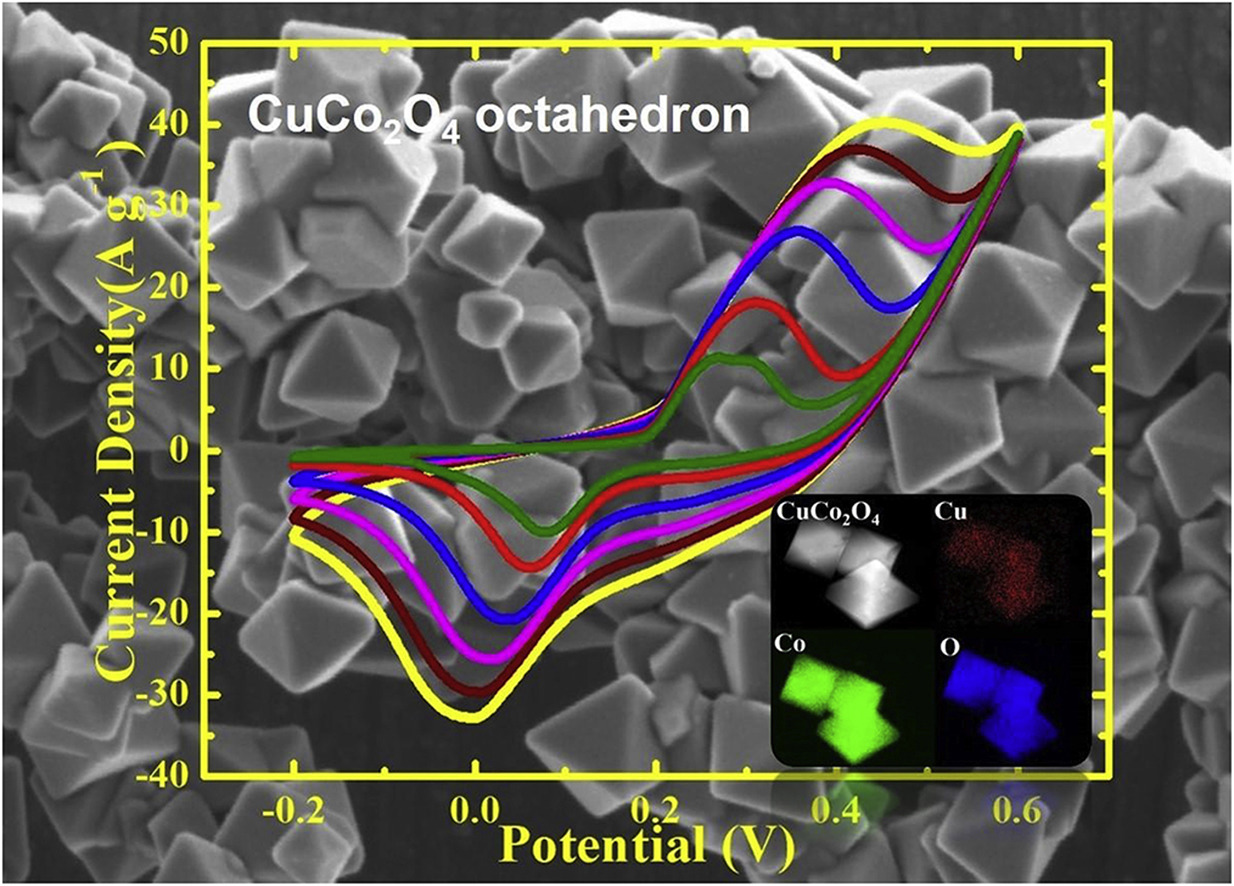
Facile synthesis of CuCo2O4 composite octahedrons for high performance supercapacitor application
Ashok Kumar Das; Nam Hoon Kim; Seung Hee Lee; Youngku Sohn; Joong Hee Lee
Composites Part B: Engineering 2018, 150, 269-276. DOI ↗ 📊 인용 ↗
📄 Abstract ▾
Shape tailoring of active materials could alter the performance of supercapacitors. Herein, we report the ethylenediaminetetraacetic acid (EDTA) assisted hydrothermal approach for the synthesis of single crystalline CuCo2O4 octahedrons and their application in a supercapacitor. Morphology and BET surface area analysis demonstrates the formation of CuCo2O4 octahedrons with a surface area of 61.97 m2 g−1. As an active material, the CuCo2O4 octahedrons exhibited a high specific capacity of 989 C g-1 at 5 mV s−1. In addition, a long-term cyclic stability with 87% of its initial specific capacity retention was achieved after 5000 cycles at 10 A g−1. This outstanding performance could be ascribed to its unique octahedron morphology. The electrochemical results demonstrate that CuCo2O4 with such a unique octahedron architecture could be a potential active material for the development of a high performance supercapacitor.
- 4
Green Synthesis of Anatase TiO2 Nanocrystals with Diverse Shapes and their Exposed Facets-Dependent Photoredox Activity
Nitish Roy; Yohan Park; Youngku Sohn; Kam Tong Leung; Debabrata Pradhan
ACS Applied Materials & Interfaces 2014, 6, 16498-16507. DOI ↗ 📊 인용 ↗
📄 Abstract ▾
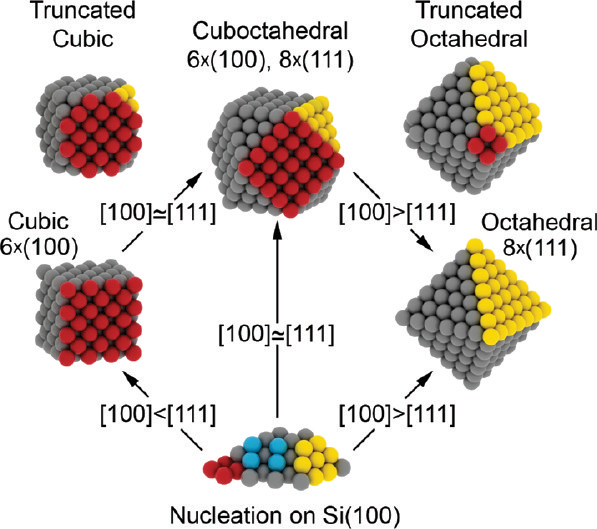
The exposed facets of a crystal are known to be one of the key factors to its physical, chemical and electronic properties. Herein, we demonstrate the role of amines on the controlled synthesis of TiO2 nanocrystals (NCs) with diverse shapes and different exposed facets. The chemical, physical and electronic properties of the as-synthesized TiO2 NCs were evaluated and their photoredox activity was tested. It was found that the intrinsic photoredox activity of TiO2 NCs can be enhanced by controlling the chemical environment of the surface, i.e.; through morphology evolution. In particular, the rod shape TiO2 NCs with ∼25% of {101} and ∼75% of {100}/{010} exposed facets show 3.7 and 3.1 times higher photocatalytic activity than that of commercial Degussa P25 TiO2 toward the degradation of methyl orange and methylene blue, respectively. The higher activity of the rod shape TiO2 NCs is ascribed to the facetsphilic nature of the photogenerated carriers within the NCs. The photocatalytic activity of TiO2 NCs are found to be in the order of {101}+{100}/{010} (nanorods) > {101}+{001}+{100}/{010} (nanocuboids and nanocapsules) > {101} (nanoellipsoids) > {001} (nanosheets) providing the direct evidence of exposed facets-depended photocatalytic activity.
- 5
Cellulose-Based SERS Substrate for Vapor-Phase Thiol Detection with PCA for Enhanced Chemical Selectivity
Ba-Thong Trinh; Sy Khiem Nguyen; Dayeon Kim; Huu-Quang Nguyen; Jaebeom Lee; Youngku Sohn; Ilsun Yoon
Chemosensors 2025, 13, 101. DOI ↗ 📊 인용 ↗
📄 Abstract ▾
In this work, we present a low-cost, label-free cellulose-based paper SERS (Surface-Enhanced Raman Scattering) substrate for the sensitive detection of thiol compounds. Uniform silver nanoparticles (AgNPs) were synthesized on cellulose filter paper via in situ reduction of a silver precursor under UVC irradiation, achieving a high SERS enhancement factor of 8.5 × 10⁶. The Ag-cellulose substrate demonstrated reliable detection of benzenethiol, capturing its characteristic SERS signals with remarkable sensitivity. Quantitative analysis was enabled by adjusting exposure times for accurate calibration. Furthermore, Principal Component Analysis (PCA) was successfully employed to distinguish mixed samples of benzenethiol, hexanethiol, and propanethiol, showcasing the substrate’s capability in separating complex mixtures. This cellulose-based AgNP platform offers a sustainable, cost-effective solution for rapid chemical detection, with significant potential for real-world applications such as environmental monitoring and food safety.
- 6
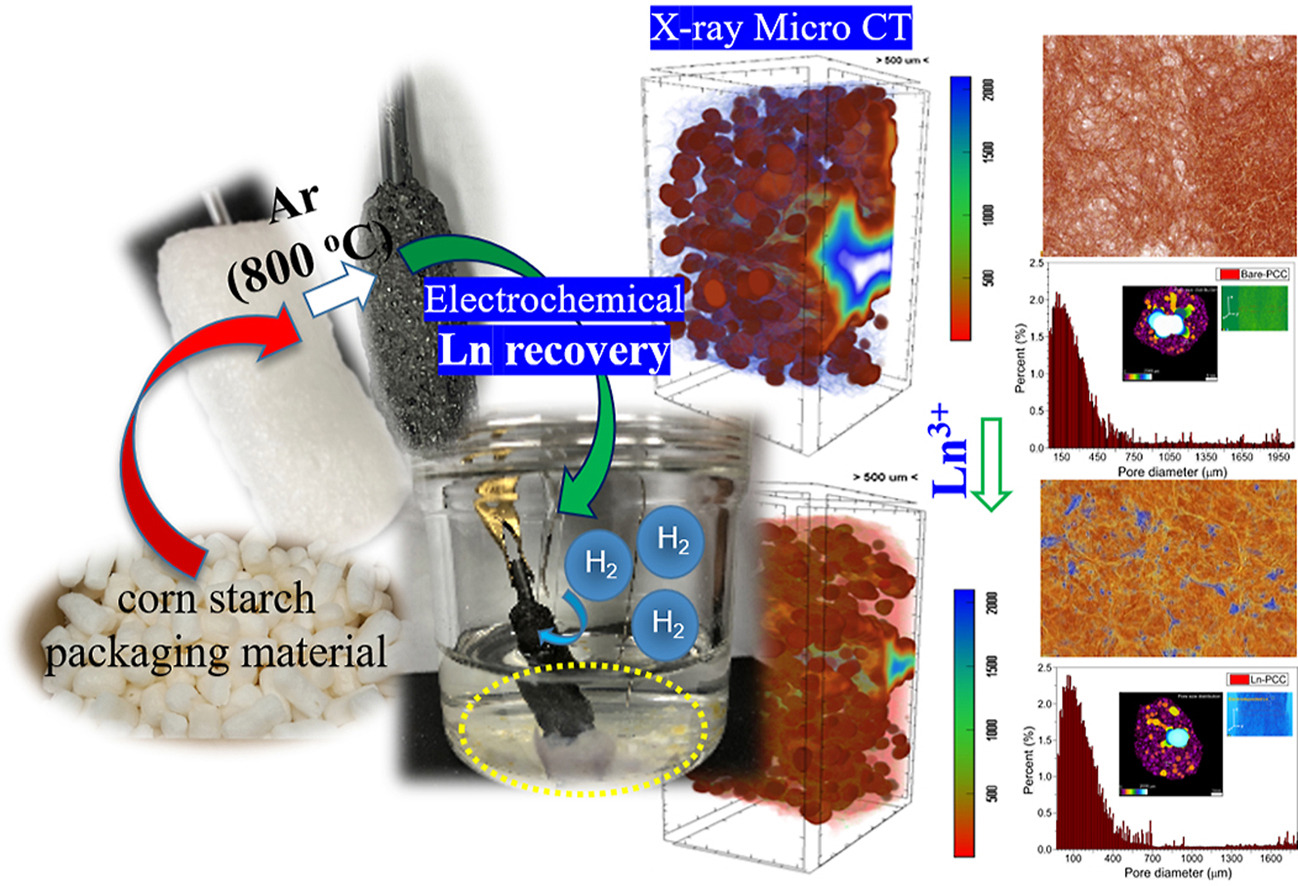
X-ray micro computed tomography and efficient electrochemical recovery of lanthanides on porous carbon cylinder electrodes
Min Hee Joo; So Jeong Park; Sung-Min Hong; Choong Kyun Rhee; Dongsoo Kim; Gisu Ji; Sung Woo Lee; Youngku Sohn
Composites Part B: Engineering 2022, 231, 109590. DOI ↗ 📊 인용 ↗
📄 Abstract ▾
Porous carbon cylinder (PCC) electrodes were prepared by thermal treatment of used corn starch packaging materials at 800 °C under Ar condition. The recycled PCC electrodes were first used to successfully recover lanthanide (La, Ce, Pr, Nd, Sm, Eu, Gd, Tb, Dy, Ho, Er, Tm, and Yb) ions in a 0.1 M NaClO4 electrolyte by amperometry electrodeposition. The electrodeposited materials were characterized by scanning electron microscopy, X-ray diffraction crystallography, energy dispersive X-ray spectroscopy, Raman spectroscopy, Fourier-transform infrared spectroscopy, X-ray photoelectron spectroscopy, temperature programmed reaction spectrometry, fluorescence (FL) spectroscopy, and real-time FL measurement for electrodeposition kinetic analysis. X-ray Micro computed tomography (X-ray micro-CT) was first successfully employed to examine open and closed pore 3D images for PCC before and after electrodeposition. Hydrogen storage property of PCC was also demonstrated. The present study showed very unique information for the preparation of PCC by recycling of used corn starch packaging materials, hydrogen storage, electrochemical recovery of lanthanide elements using the PCC, and inner and exterior 3D image processing of PCC using X-ray micro-CT.