Sohn and Yoon Groups Convert Water and CO₂ Using Only a Pulsed Laser
2026-09-14
Published in Advanced Functional Materials
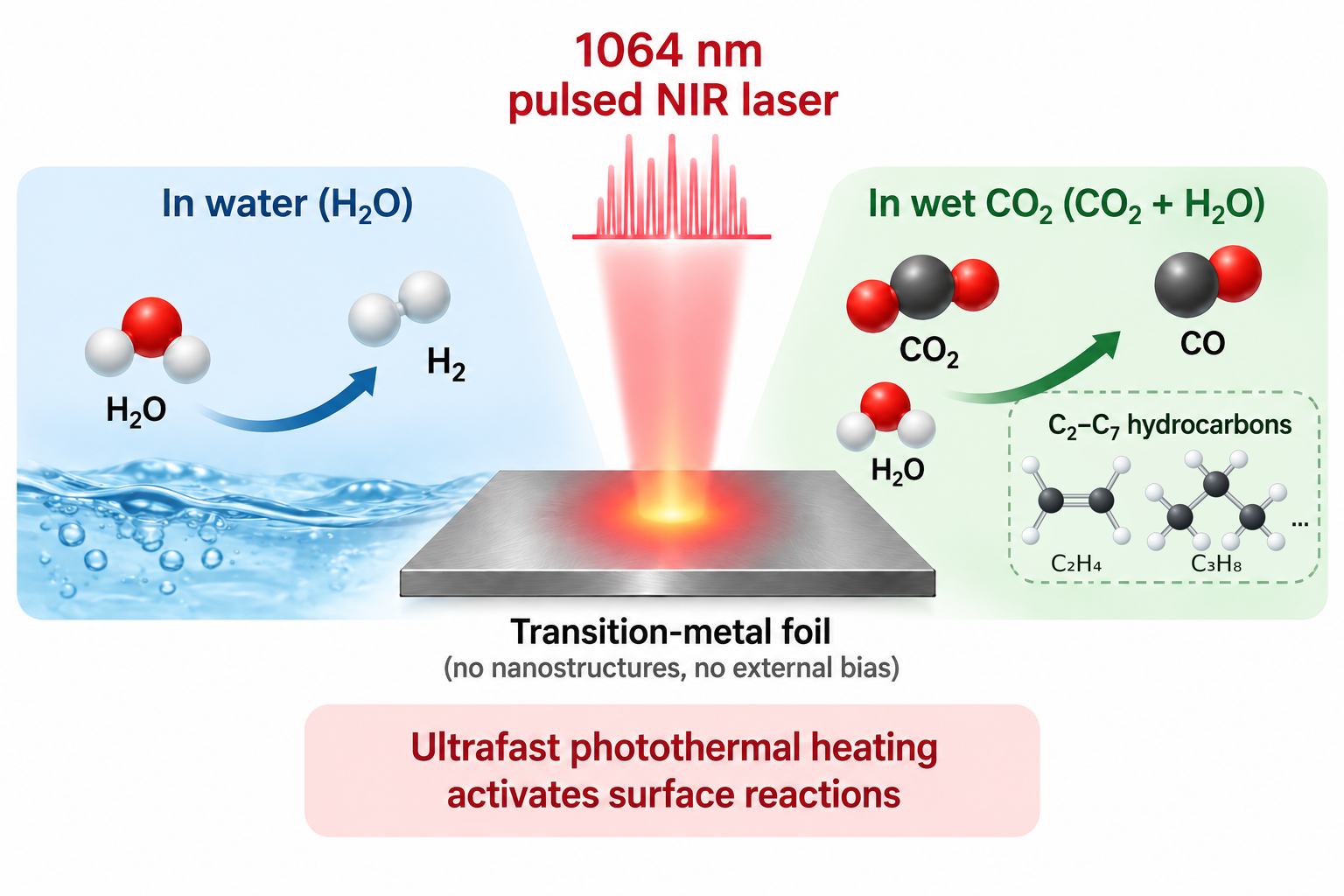
- No nanostructures, no semiconductor absorber — the reaction runs on plain transition metals under a near-infrared laser
- Hydrogen from water; carbon monoxide and C₂–C₇ hydrocarbons from humid carbon dioxide
Water and carbon dioxide can be turned into useful products simply by shining a near-infrared pulsed laser on a commercial transition-metal foil, with no nanostructuring and no semiconductor light absorber. The result points to a much simpler route to solar-thermal, carbon-neutral processing.
A joint team led by Prof. Youngku Sohn (Energy Environment Solution Laboratory) and Prof. Ilsun Yoon (Nano-Photochemistry Laboratory) of the Department of Chemistry, College of Natural Sciences, drove both water splitting and CO₂ conversion on untreated transition-metal foils using 1064 nm nanosecond near-infrared laser pulses — without applying any external bias.
The work appears in Advanced Functional Materials (2025 JCR IF 19.9, top 4.2% in JCR). Prof. Sohn and Prof. Yoon are co-corresponding authors, and Hyojin Nam, Sy Khiem Nguyen and Seon Young Hwang are co-first authors.
Driving water or CO₂ chemistry with light normally calls for a purpose-built plasmonic nanostructure or a semiconductor absorber. Those materials are demanding to fabricate, which has limited how far such schemes can be carried into practical processes.
Here the team took a different route: no nanostructuring, no electrodes — only a near-infrared pulsed laser on a commercial metal foil. Because the reaction is driven by the momentary photothermal effect of each pulse rather than by an applied voltage, the approach departs from conventional photoelectrochemical designs.
In water, the metal–liquid interface heats instantaneously and hydrogen evolves. Under a humid CO₂ atmosphere, carbon monoxide forms along with hydrocarbons spanning C₂ to C₇. The analysis indicates a Fischer–Tropsch-like pathway, in which surface hydrogen atoms and CO intermediates combine and the carbon chain grows.
Simulations showed that each laser pulse heats a narrow region of the metal surface past the threshold the reaction requires. Heat also accumulates between pulses, lowering the apparent activation energy substantially — which explains why repeated pulsed irradiation keeps driving the conversion of water and CO₂.
The significance of the study is that water splitting and CO₂ conversion were achieved with a transition metal and a laser alone, without elaborate nanofabrication or a separate electrode system. The simplicity of the setup is favourable for scaling up, and follow-up work is expected to develop the approach toward green hydrogen production and CO₂ utilization.
“What matters here is that we drove the conversion of water and CO₂ with nothing but a transition metal and a pulsed laser — no nanofabrication, no external bias,” Prof. Sohn said, “and we will continue to raise the efficiency and selectivity of laser-driven photothermal reactions so that the approach can grow into a technology for green hydrogen production and CO₂ utilization.”
Paper Photothermal CO₂ and H₂O Reduction via Pulsed Near-IR Activation of Transition Metals